
Jefferson County Deed Types
Every deed carries a type on its face. That label matters. Not every deed promises the same interest in Jefferson County land. The Register of Deeds index lists ordinary deeds beside quitclaim, correction, trustee, sheriff, tax, executor, administrator, cemetery, transfer-on-death, and deed-with-vendor-lien forms. Read the signed document itself. An index label is only a finding aid. The recorded image holds the parties, execution details, legal description, exhibits, and any limits written into the transfer.
| Deed Type | What It Does | Common Use |
|---|---|---|
| Warranty deed | Conveys the stated interest with warranties written in the instrument | Conventional land transfer |
| Quitclaim deed | Conveys whatever interest the grantor has without adding a title promise | Interest cleanup or family transfer |
| Correction deed | Corrects a defect or fact in an earlier recorded deed | Name or legal-description correction |
| Trustee, executor, or administrator deed | Conveys through a fiduciary role | Trust or estate administration |
| Sheriff or tax deed | Records a transfer after the applicable legal process | Court sale or tax-sale conveyance |
Not everything filed beside a deed conveys ownership. A mortgage secures a debt. A release points back to an earlier filing. A lis pendens signals pending litigation, not a final title result. So Jefferson County deed research tracks document types and reference numbers rather than just matching names.
Search the Jefferson Deed Index
The county-linked Jefferson County Land Records site opens several doors into one recorded index. Name searching runs in grantor, grantee, or both-party mode. Filters cover date ranges, instrument groups, and instrument types. You can also choose broad or exact name matching. Separate forms accept a control number, book and page, reference number, refers-to book/page, or up to three instrument types. Those precise routes pay off when a broad surname drags in lenders, lien claimants, trustees, or near-namesakes.
| Index Route | Fields to Enter | Best Use |
|---|---|---|
| Party name | Name, grantor/grantee mode, date span, group or type | Find a transfer involving a known party |
| Book and page | Book type, book number, page | Open a citation found in another instrument |
| Control or reference | Control number or segmented reference | Retrieve an exact indexed filing |
| Refers-to | Prior book/page, exact or range mode | Follow a release, assignment, or correction |
| Instrument type | Up to three types and a date range | Narrow a deed, lien, plat, or release sweep |
A result row is a starting point, not the whole Jefferson County deed record. The hit list shows image and detail links. It also lists grantor or debtor, grantee or secured party, legal-description text, date, book or file number, document type. Cross-reference appears there too. Open the image when one is available. Then compare the legal description and parties against the parcel evidence. View the county deed name-search form. Its party modes and filters let a careful query cut far tighter. A plain name search can't do that.
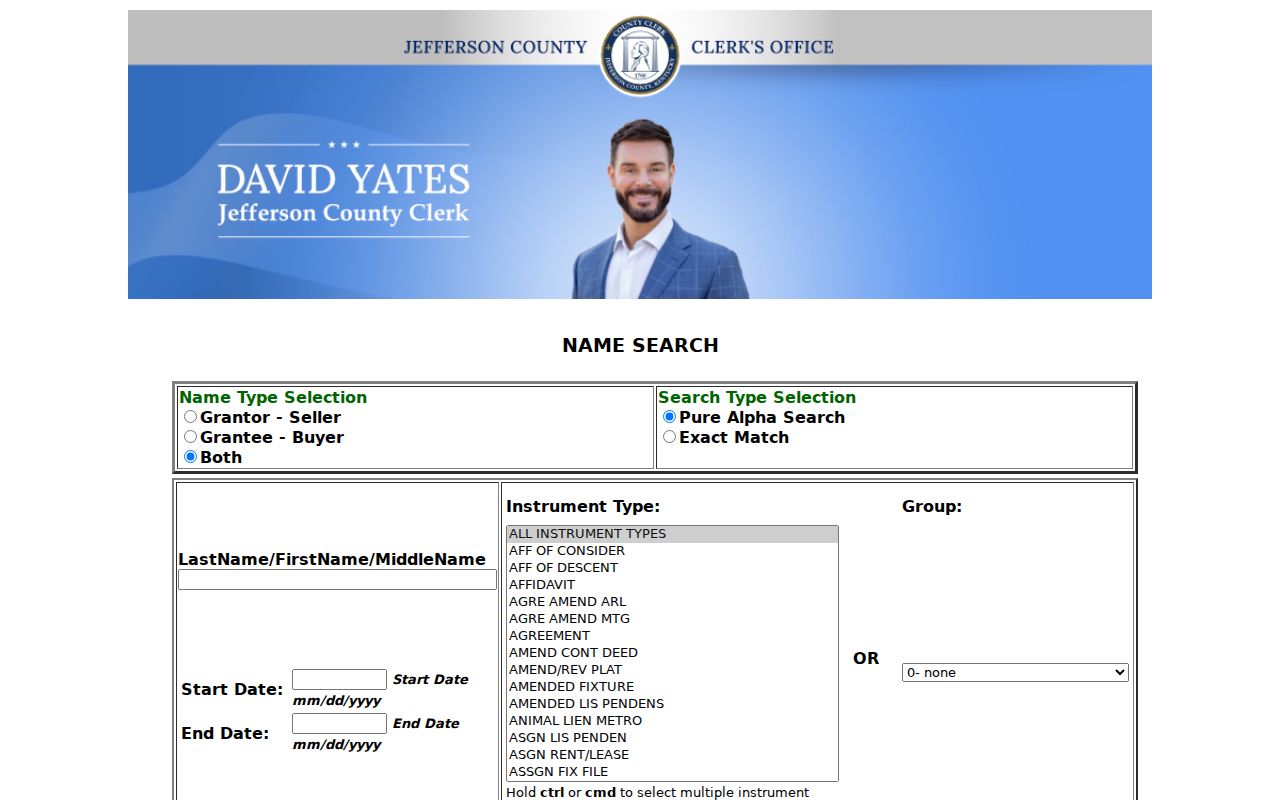
The form gathers grantor, grantee, date, group, and instrument controls in one place. Note the settings on every saved query.
Build the Jefferson County Chain
A chain of title is the ordered run of transfers tied to one piece of land. Start from the newest reliable deed citation. Work back one transaction at a time. Names alone make weak joins. Record the legal description, book and page or file number, dates, deed type, and cross-references at each step. If the assessment-roll owner differs from the newest grantee, date both records first, since the annual tax record may lag a later recorded transfer.
- Locate the current acquisition deed with the present grantee, parcel clue, and legal description.
- Read the grantor and the cited book, page, file, and cross-reference from that deed.
- Search that grantor as a grantee in an earlier date span, then match the land description.
- Repeat while logging gaps, correction instruments, probate orders, and name variants.
- At the remote cutoff, continue with the public terminal, deed books, microfilm, and archive catalog.
- Grantor
- The party conveying the stated interest.
- Grantee
- The party receiving the stated interest.
- Chain of title
- The linked sequence of recorded transfers for the same land.
- Book/page
- A volume-and-page citation used to retrieve a recorded instrument.
- Control or file number
- A distinct number assigned to a filing in the index.
Jefferson Records Split at 1995
Online access starts at 1995. Jefferson County adds documents in reverse chronological order from that line forward. That boundary limits access, not the record itself. The Kansas Historical Society catalog describes Jefferson County holdings reaching from 1855 through 1982. Those holdings include deed and mortgage microfilm, probate, district court, assessment, roads, plats, and city records. The county's own historical sources reach back to the mid-1800s too. Pre-1995 deeds take legwork. Carry the last online book/page, party, and legal description to the Register's public terminal. Ask for the deed book or film from there. KSHS may hold a film run or oversize map. Try it when the county catalog runs thin. Keep the addition, block, lot, section, township, range, road, river, or town name, since those older locators can bridge a historic filing to a current parcel even without a street address.
Note: The 1995 date limits remote access; it does not limit the age of Jefferson County deed records.
Follow Releases and Corrections
Jefferson County's instrument list rewards close attention to references. An assignment, subordination, modification, correction, or release often names different parties than the first deed or mortgage. Search the exact reference number first. Try the refers-to book/page as well. Only then broaden by name. Compare the prior instrument against the new PDF, since a release can settle one filed claim while other liens or interests stand. The county filing checklist has teeth. It requires a mortgage release or assignment to identify the earlier book/page or document number. It also calls for an instrument date, filing in Jefferson County, a complete legal description, grantor marital status, and a sales-validation questionnaire or exemption where applicable. Those details separate lookalike results.
Recording Rules for Jefferson Deeds
Jefferson County's Register's recording requirements demand an original or certified copy. Every page must be legible. Names need signatures plus printed forms, a complete notary block, and a full legal description. A tax-statement shorthand will not stand in for that description. Payment and the statutory fee go with the filing. A recording clerk who accepts and indexes the document is not certifying clear title. Nor is the clerk giving legal advice.
Preparation pays off at the counter. Review the county filing checklist before preparing a deed, mortgage, release, or modification.
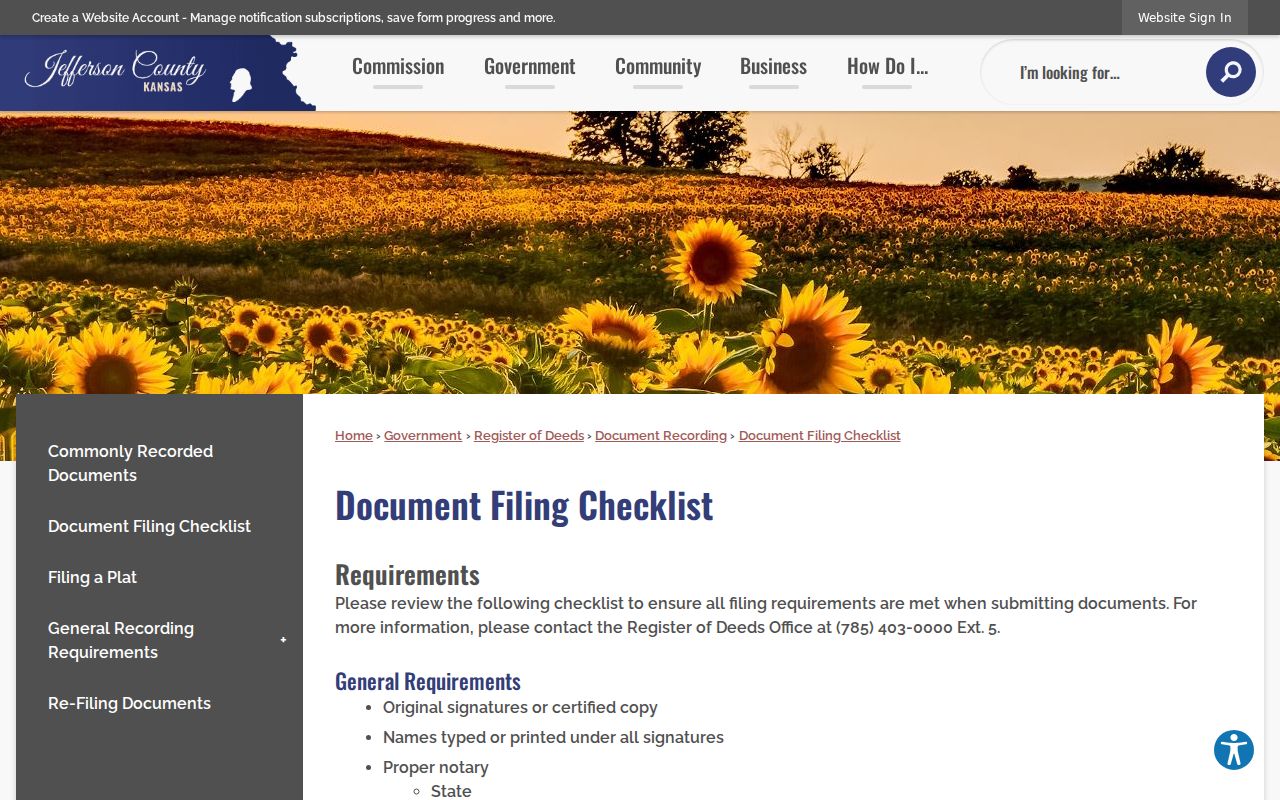
A checklist like this shows why prior document references, a full land description, and party details belong in a working title-chain log. That log saves time later.
Jefferson County Deed Fees
The county fee schedule lists deeds, mortgages, and similar instruments at $21 for the first page. Each added page is $17. Certification adds $13 to any instrument. General office copies run $0.25 per page. Fax, email, and mail copies cost $1 per page. Research costs $20 per hour. Staff time over fifteen minutes but under an hour is billed at $10. Confirm the current amounts before ordering or filing, since schedules change.
Remote access follows a separate price path. Laredo costs $75 per month for each license and password. Tapestry charges $5.95 per search plus $0.50 per printed page with credit card payment. The office schedule allows checks only. Pick a route by frequency, date range, and need for a certified copy rather than by the first screen you reach.
Free Alerts for New Filings
Jefferson County offers a free Fidlar Property Fraud Alert. Enroll a name and get email or phone notice whenever a document is recorded under it. The alert is not a block on recording. It also proves nothing about a filing's validity. Treat any notice as a prompt to open the Register's index and the recorded image, then compare the parties, legal description, document type, and cross-references before acting.
An unexpected paid deed-copy solicitation is not the county's free alert. Scammers sometimes dress up solicitations that way. Verify the instrument with the Register of Deeds. Request a certified copy whenever the use requires one.
Obtain a Jefferson County Deed
Start with the remote image if the Jefferson County deed record sits within online coverage. Need fuller access? Use the public terminal at the Register of Deeds, 300 Jefferson Street in Oskaloosa. The office is open Monday through Friday, 8:00 a.m. to 4:30 p.m. Staff also take calls at 785-403-0000 extension 5. Mail works too. Send requests to PO Box 352, Oskaloosa, KS 66066. Offer a control number or book and page when you have one, plus the parties, deed type, recording period, and legal description.
Ask for a plain copy for information only. Ask for a certified copy when an authenticated office version is required. Records beyond remote coverage come through the terminal, bound books, or microfilm. A focused KORA request can reach a county record the standard counter process does not handle, subject to exemptions, reasonable actual costs, and possible prepayment.
Recorded, not guaranteed. Jefferson County deed records show what the office accepted and indexed. They are not a title opinion, and unrecorded interests may exist.