
Build a Jefferson County Former-Owner Timeline
Begin with a verified current deed and open one row for every transfer. The evidence worth keeping includes names, dates, instrument types, and recording references. Repeat the exact land description in each row. When it shifts, note the subdivision, split, replat, or correction that explains the change.
| Transfer date | Grantor to grantee | Deed type | Book/page or control |
|---|---|---|---|
| Newest matching recording | Prior owner to present grantee | Warranty, quitclaim, representative, or other deed | Exact modern index locator |
| Prior acquisition | Earlier grantor to that prior owner | Instrument as indexed | Book/page, file, or control number |
| Plat or parcel change | Developer, dedicator, or affected parties | Plat, replat, correction, vacation | Recorded plat reference |
| Older book entry | Historical grantor to grantee | Deed or land instrument | Volume, page, reel, and repository |
Let the instruments prove the sequence, not surnames or nearby dates. A warranty deed and a quitclaim deed carry different assurances, yet either one can legitimately anchor a link in the chain. Estate, probate, sheriff, tax, and court-related transfers often require a second record set to show why the grantor had authority to convey the parcel at all.
Cross Jefferson County's 1995 Online Cutoff
Jefferson County offers remote land-record access covering 1995 onward. That cutoff is a boundary of online convenience, not the start of county ownership records. Once a deed chain hits 1995, the work continues with Register of Deeds public terminals, staff-assisted books, microfilm, and archival holdings in the office. Older property records still exist. They simply live in different formats.
The county internet-access page also documents Laredo at $75 per month for each license and password, Tapestry at $5.95 per search plus $0.50 per printed page, and free public-terminal access to the same county records in the office. Cite the source and access date, since interface prices can change.
The online chain stops at 1995. Earlier former owners require the courthouse books, microfilm, or archives; absence from remote results is not absence from the land record.
Use Jefferson County Grantor and Grantee Roles
The Jefferson County deed name form lets a researcher choose Grantor-Seller, Grantee-Buyer, or Both. Pure Alpha broadens name matching. Exact Match narrows it. Find the current grantee's acquisition first, then treat the grantor from that deed as the grantee in the next property search, repeating the loop backward through the deed records.
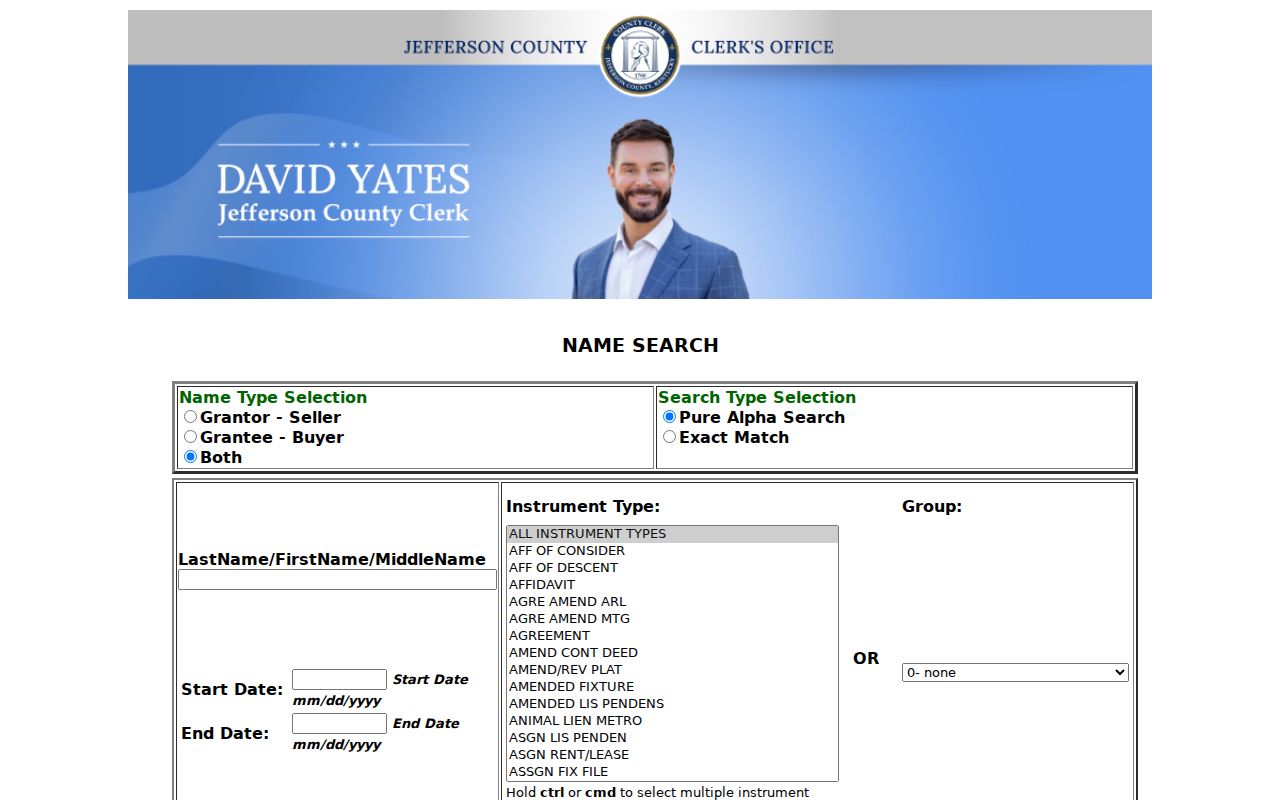
Date limits, optional name parts, instrument types, and index groups help separate actual transfers from mortgages, releases, liens, and same-name recordings that clutter the deed records. Preserve spelling variants exactly as the recorder entered them rather than silently correcting an old entry.
Walk the Jefferson County Deed Chain Backward
A backward chain is a repeatable loop. Every deed hands you the party and recording clue needed to locate the previous conveyance in the Jefferson County property records. Compare the land itself, not merely the people, at each step.
- Find the newest deed whose grantee and legal description match the current parcel.
- Copy its grantor, recording date, instrument type, book/page or control number, and full legal description.
- Search that grantor as an earlier grantee, then verify the same tract in the resulting acquisition deed.
- Repeat until the remote cutoff, then continue with the exact book and index trail at the courthouse or archive.
- Grantor
- The party conveying the interest shown by the instrument.
- Grantee
- The party receiving the interest shown by the instrument.
- Chain of title
- The ordered sequence of conveyances affecting the same land.
- Reverse index
- An index organized to support searching a party in the opposite deed role.
- Quitclaim and warranty deed
- Different conveyance forms that must be recorded and read on their own terms.
Extend Jefferson County Previous Owners Into the 1850s
The Kansas Historical Society Jefferson County collection spans 1855 to 1982. Its holdings include Register of Deeds material. Assessment and tax rolls are part of it too. The same collection holds district and probate court records, maps, city records, and microfilm. Collection notes describe a broad microfilm range running from 1853 to 1920. These are repository descriptions, though, not a guarantee that every volume or year survives complete. The catalog page serves as a visual entry point for searching older property records.
The FamilySearch catalog item for Jefferson County is an 1875 county index rather than a deed book. It can add residence and township context, but it cannot prove a former owner. Ask KSHS or the Register of Deeds for the exact volume, reel, box, or oversize map needed.
Keep Jefferson County Plats in the Ownership Chain
A chain can look broken simply because the land changed shape. A deed referencing lot, block, and addition calls for the recorded plat. It also calls for any replat, correction, vacation, dedication, or street closing. A fractional section description means preserving section-township-range. Watch for later lot splits or subdivisions.
Jefferson County requires an original mylar for a plat filing. It also requires surveyor participation, signatures, approvals, tax-receipt evidence, and detailed contents. Those requirements make the plat a land record in its own right. A plat explains why an old parent tract and a modern parcel card use different words. The ownership chain never actually broke.
Oskaloosa's July 1856 town layout of blocks, streets, and alleys offers a local example. Valley Falls was platted in 1855 under older name geography. Search both modern and historic place terms whenever the deed language points to them.
Bridge Jefferson County Estate and Court Transfers
Probate, partition, foreclosure, and tax-sale events can interrupt a tidy seller-to-buyer pattern in Jefferson County property records. A deed may name an estate or a representative. It may not explain the authority behind the transfer. In that situation, search Kansas CaseSearch. You can also ask the district-court clerk for the governing order. Then match its legal-description exhibit and case number to the deed that followed.
A probate docket by itself does not establish a new owner of record. Keep the will or letters only when relevant. Also keep the sale or distribution order, the representative's name, and the resulting Register of Deeds instrument. A tax-sale notice is not a completed conveyance either. The sale, redemption, confirmation, and later deed can each create separate dated events in the tax roll and deed records.
Note: Kansas CaseSearch is a discovery system, not the official court record, and sealed or older material may require clerk access.
Test Jefferson County Past Owners Against Maps and Notices
Old atlases and newspapers can carry a Jefferson County ownership question past what the deed books alone show. An atlas page names the landowners of record at one moment. It also marks roads, streams, mills, schools, and townships. A newspaper notice might reveal a sheriff sale, tax sale, plat, rezoning, petition, or hearing. Each source dates a clue. Neither one replaces the deed, court order, ordinance, or signed plat behind it.
The Kansas Newspaper Database lets you narrow by city, title words, county, state, and year range. Sort controls are included. Run the exact owner name first. Then try the subdivision, township, road, and historical place spellings, since names drift across decades. Kansas residents can request microfilm through library interlibrary loan. The Jefferson County Public Library supplies genealogy databases plus its Book a Librarian appointment for hands-on help.
The county's historical-research page rounds out the picture with cemetery deeds and plats. It also offers old atlases, marriage-license information from 1855 to 1930, and burial or tombstone material spanning 1854 to 1986. Evidence like this can explain a surname, an institution, or a place name. That matters when a straightforward property search stalls. Still, every thread must be tied back to a deed book and a legal description. Only then does it earn a spot in the ownership timeline.
How Far Back Jefferson County Former Owners Go
Jefferson County was formally established on August 25, 1855. Local historical materials reach back to the mid-1800s. The KSHS collection opens in 1855, and its microfilm notes reach even earlier. So a pre-county land trail may run through territorial records. It may also run through federal land-survey or patent material and neighboring jurisdictions instead of a tidy county deed.
No courthouse fire, destroyed-volume list, or book-by-book digitization schedule appears in any published Jefferson County account. Do not invent a gap. Mark the last deed you proved and the repository you searched. Then ask the Register of Deeds or KSHS whether an earlier index, deed book, reel, or federal source survives.
Use history responsibly. Former-owner research supports house history, estate work, and purchase diligence. Never use names or addresses to track, harass, intimidate, or harm a living person.
Close the timeline with source citations, access dates, and any unresolved links noted plainly. For the present administrative record, the Jefferson County current owner page keeps the inquiry in the present tense. Preserve each former owner's indexed spelling, party role, deed date, recording date, and exact locator. That discipline makes the next property records search reproducible and keeps later corrections visible.